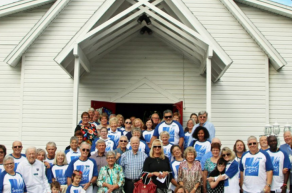
The importance of legacy is firmly rooted in the minds and hearts of the parishioners of All Saints Episcopal Church in Tarpon Springs, FL. I interviewed The Reverend Janet Tunnell, the rector, James Rissler, chair of the Funding our Future committee, and Ellen Lightner, chair of the Perpetual Light Legacy Society, to learn how creating a legacy society helped and is continuing to help All Saints grow the church’s endowment for the future.
Continue reading...

Jesus was not a white guy. The paintings you may have seen, portraying him with sandy-colored hair and blue eyes, are figments of the European imagination. Jesus was a Palestinian, and he looked like one. If he were living in the U.S. today, we’d see him as a “person of color.”
That’s just the visual impression, though. In Jesus’ world, there was no such thing as a “nuclear family,” Mom, Dad and the kids. In those days, families were large and extended; kids growing up saw their aunts and uncles and cousins all the time. People didn’t move around if they could help it; local communities were close-knit.
Continue reading...

“Fourteen parishes,” she told me that afternoon, noting that my jaw just about dropped. “Yes, I’m the Team Vicar of fourteen parishes.”
“Wow, that makes the two churches I serve as part of one parish, and the third as priest-in-charge kind of pale in comparison,” I responded.
My new colleague and I were enjoying lunchtime conversation in the refectory at Sarum College, just across the lawn from Salisbury Cathedral. The site of the former Salisbury & Wells Theological College, Sarum College is very much a working, albeit non-residential seminary. In fact, it’s a remarkable, vibrant center for theological formation and renewal for all orders of ministry! It’s a great place for anyone, including Episcopal priests on sabbatical like me, to spend any time, really. Simple accommodations, great staff, nice meals, a stone’s throw from one of the world’s great Cathedrals, and a dynamic, buzzing place where one can really get a sense of what life is like on the ground in the Church of England.
Continue reading...

My seminary was a huge brick building circa 1960 or so. It was originally a seminary for Jesuit priests, and now houses a retirement community and nursing home for Catholic clergy, and functions as a large retreat center for many different groups.
One weekend a month for three years I would ride along as my friend Jan drove down the long, tree-lined drive. We’d park and lug a weekend’s worth of luggage inside, and before we were even in the doors our community would begin to form via shouted greetings in the parking lot and warm hugs in the lobby.
The Academy for Vocational Leadership is an Iona Collaborative school and is made up of many bi-vocational students and staff. On these long weekends we learned Church History, Systematic Theology, the Bible and literally dozens and dozens of practical courses, everything from music in small churches to Asset-Based Community Development.
Continue reading...

It’s okay to start backing off the Zoom live-feed and hybrid worship offerings. I remember the refrain, that we’re going to keep live-streaming until Jesus comes home. But now, as we enter a new phase of the pandemic (but still very much with Covid), I believe our opportunity is to reflect critically on our priorities and approach to community-building, especially double-check our use of technology and the goals we’re pursuing as the Body of Christ.
So here are some starter invitations, or questions as we find ourselves at the dawn of a new phase of the pandemic, still walking with Covid (and all those anxieties and opportunities that came along with it):
1. If you’ve got a live-stream team, celebrate them. Your folks who invested in that technology and designed amazing systems have met the future, and they deserve a great celebration. You may wish to ask them about their longer-term plans and thinking. They may have really good ideas about where to go from here. Some may sense it’s time to wrap up the ministry, or their part in helping that ministry. Celebrate them. All of them.
Continue reading...

On sabbatical this past spring, I walked to the village of Grantchester from Cambridge. Turns out, Grantchester is very much a real village, not just a lovely PBS series. “Go to the Blue Ball,” the docent at Kings College told me when I asked for directions; “that’s the best pub.” The walk was lovely, and the inn’s hospitality and lunch were spot on.
Walking out into the afternoon sun, I saw on the wall a cartoon drawn of some characters in the village circa 1980-something: there was the barman; and a number of other characters, some in business attire, some in work clothes; and then, near the center, was a balding man in a backwards collar on a black shirt: the vicar.
Continue reading...

This month we offer five resources on youth ministry. Please share this digest with new members of your vestry and extend an invitation to subscribe to ECF Vital Practices to receive Vestry Papers, blogs, and the monthly digest.
Michael Carney writes about youth ministry during the pandemic at St. Elizabeth’s, an Episcopal mission on the Ute Reservation in northeast Utah in Youth Ministry Pandemic Style.
Continue reading...

The other day, my family and I went downtown. There’s only one incorporated town, really village center in the community in which we live. We missed the Taste of St. Mary’s by one hour – all the vendors were packing their tents – so we walked down the block, off the town square to the local pizza place for a late lunch. It’s great pizza; plus it’s fun to run into all sorts of neighbors. Following lunch, which turned out to be dinner, we walked another block over to the new ice cream place that opened last year – a storefront on an old warehouse building; the rest of the building itself now turned into a collection of real-time Etsy shops with an always-full beer garden in the back.
Years ago, none of those options were there. The buildings were there. The pizza place was a run-down seafood joint, and I have no idea what was in that warehouse. Back then, there was a diner, a coffee shop and a French restaurant and that was about it, save for a few funeral homes and florist shops. Now, the town is filled with yoga studios, art galleries, yarn shops, wonderful restaurants, a health food store, cooking studio, and so many more pop-up-shops-turned-creative-businesses.
Continue reading...

As we recommit to Stewardship each season with a focus on time and talent, let us reflect on our individual level of participation in the church’s organizations/committees/guilds or ministries. A church colleague highly recommends that we use the word ministries more often in order to 1) distinguish it from the secular organizations’ processes and mindset we adhere to and 2) to continually remind ourselves that any work we do in the church should be in service to Jesus Christ and his teachings. I agree.
On one end of the participation range, there are some in the church that can be described as oversubscribed. They belong to every organization and are either burned-out with too many meetings and commitments or they are participating in name only and do not contribute in any meaningful way. Oftentimes in smaller congregations, oversubscribing can occur with few members that need to wear multiple hats. This situation is increasingly common and challenging.
Continue reading...

And I’m not referring to Christmas but the annual pledge campaign for your congregation. Actually, this can be a wonderful time of the year if you, the church’s leadership, approaches the campaign with faithfulness, focus and follow-through.
Faithfulness needs to emanate from the top and permeate the life of the local congregation all year round not just when you’re asking for money in the fall. Being faithful involves ongoing communication with your members and constituents; offering quality worship, fellowship, and outreach opportunities; helping people discern their gifts, and engaging them in appropriate ministries and activities. Faithfulness includes sharing your personal faith journey, reflecting on the importance of the local faith community in nurturing your own spirituality, inviting others to join you on the way, and helping form disciples for Jesus. Faithfulness leads to commitment, commitment leads to embracing stewardship, and stewardship leads to generosity and giving. Even if you’ve been a little lax in this area over the past several months, this is the ideal time to be more deliberate about faithfulness.
Continue reading...

We all love stories. Storytelling is imbedded in our DNA as human beings. Stories were used to explain the unexplainable—those mysteries such as birth, death, nature and the existence of a higher power or force, eventually described as God.
People of faith, or those who follow or practice a particular religious tradition are especially fond of stories. Jewish and Christian heritage and custom have been passed down to us through stories—about creation, sin, floods, slavery, freedom, laws, prophets, angels and, ultimately, redemption and resurrection.
While we love to tell stories, we also love to talk about ourselves, especially those qualities and experiences of which we are most proud. Telling our story is an essential element of the human experience and is the precursor to making connections, establishing relationships, and falling in love.
Continue reading...

This month we offer five resources on Transformational Stewardship. Please share this digest with new members of your vestry and extend an invitation to subscribe to ECF Vital Practices to receive Vestry Papers, blogs, and the monthly digest.

The disciples had been watching their Master immersed in prayer, sitting in silence for long periods of time, and they’d learned not to interrupt. Jesus regularly went off by himself before the first light of day, seeking a deserted place to commune with the Creator. The disciples could feel the power of those times and yearned to experience that for themselves. “Lord,” they asked, “teach us to pray.” (Luke 11:1)
So Jesus gave them some words of prayer: calling on God’s Name, proclaiming the coming of a holy kingdom and their dependence on the Creator, seeking forgiveness “for we forgive everyone,” and asking for help when trials come. This simple version of the Lord’s Prayer (expanded in the Gospel of Matthew) has such an impact that we still say it today. It probably wasn’t new to the disciples—we can all use a reminder—but from their disappointed looks, something more was needed.
Continue reading...

As I write this blog I am in Abilene, Texas with my wife, Margaret, visiting our son David and his family – part of a month-long road trip during my six-week sabbatical. (David is Rector of the Church of the Heavenly Rest in the Diocese of Northwest Texas.) Our first stop from Connecticut was western Maryland, where Margaret’s brother hosted the annual family reunion followed by a visit with old friends from Hartford in Oklahoma. While there will be stops along the way, the next few weeks will include additional visits with family and friends in South Carolina and Virginia. All these summer gatherings continue to be wonderful opportunities for relaxation, refreshment, and reconnection.
Continue reading...

After five years of ordained ministry in parishes, and three teaching in a private school in New York City, I decided I would like to teach in one of the Episcopal seminaries. For that I would need a deeper academic background, so I pursued a Ph.D. in American Religious History at Harvard, specializing in 19th-century Episcopal history. I was especially interested in looking at the interaction of religion and culture. I was supported in this work for three years by a Fellows grant from the Episcopal Church Foundation. For my dissertation, I looked for the story of a church in an anomalous relationship to its diocese, thinking this would open a window into the religion and culture of the period. Soon I discovered St. Philip’s Church of New York City, the second Black Episcopal congregation in the country. St. Philip’s was listed in the annual diocesan journal for decades as “(colored - not in union with the diocese),” with occasional minor variations in wording. But no Episcopal parish can exist outside of the diocesan structure! My dissertation thus became the story of the 40-plus-year struggle of St. Philip’s to move from its founding in 1809, through the ordination of Peter Williams as the second Black priest in the denomination, to a regular worship life with the Book of Common Prayer and visitations by bishops, to only finally having its delegation admitted to the diocesan convention in 1853. It was a fascinating story with a great cast of characters, and after I spent a couple summers re-writing it into a more narrative form, it was published in 2005 by Columbia University Press as Faith in Their Own Color: Black Episcopalians in Antebellum New York City.
Continue reading...

We live in a glut of information. Practically anyone can find any information or opinion that they wish if they put a few minutes of effort into it. As a result, people tend to mistrust scholarship. “I can think for myself!” is the constant refrain. Or, as I saw recently on Facebook, “We are all theologians by right of our baptism.”
In such a world, why on earth would I put the time, money, and effort into becoming a scholar? Why would anyone listen to a theologian?
The truth is: theological scholarship is so much more than just reading books.
Continue reading...

This month we offer five resources on Welcoming Families in Worship. Please share this digest with new members of your vestry and extend an invitation to subscribe to ECF Vital Practices to receive Vestry Papers, blogs, and the monthly digest.
Continue reading...

When is the right time to hand over responsibilities in our congregations and ministries and how to do so effectively are important questions to consider? Whether it is the Vestry, Altar Guild, Diocesan Council or ECW, we need a plan.
In determining when to handoff, for some, term limits are the necessary guardrails to ensure that we do not keep the same responsibilities indefinitely. For others, the term “over my dead body” was created, with a staunch refusal to handoff, threatening instead to leave the ministry or withhold their tithes.
The obvious advantage for letting go is that it allows new ideas and perspectives to be introduced and it makes room for the gifts of others to be exercised. This is especially important as we strive to allow young adults to have meaningful responsibilities and also welcome those who are newcomers to the church or to our faith or existing members who feel left out of church life.
Continue reading...
“Where there is no vision, the people perish.” Proverbs 29: 18
Would you give money to a cause not knowing how it would be spent? Most people give to causes that affirm their cherished values, but donors are more likely to give when they know an organization will use their gift wisely … and believe the gift will make a difference. Churches face increasing competition for the time, attention, and money of their parishioners. Donors who care will give when they are moved by your mission, understand your plans, and trust you.
Continue reading...
 RSS Feed